
Compare the general models
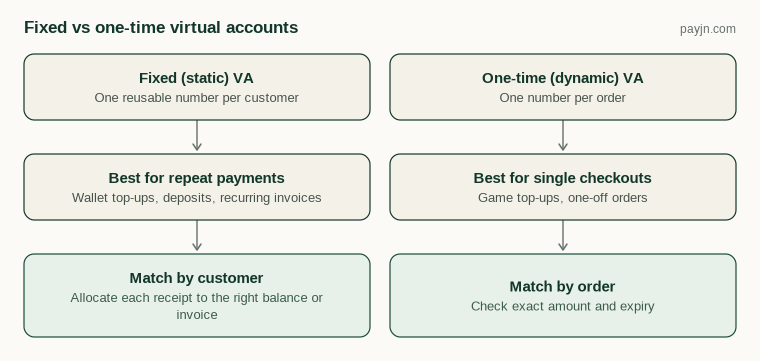
| Model | General behavior | Matching work to plan |
|---|---|---|
| Fixed or static | The same number is assigned to a customer for repeat payments | Identify the customer and allocate each receipt to the right invoice or balance |
| One-time or dynamic | A number is associated with a particular order or payment | Link the receipt to that order and handle expiry or abandoned checkout |
PAYJN supports both models on its commonly used bank routes. Confirm the actual reference rules for each approved bank route rather than assuming every account number behaves alike.
Reusability and amount rules also need separate checks. An open-amount configuration lets a customer choose an amount; a closed-amount configuration expects the invoice amount. Do not infer amount behavior merely from the words static or dynamic.
Choose around your customer journey
- For individual checkout purchases or game top-ups, consider whether an order-specific reference would simplify matching each payment to one delivery.
- For repeat customers, consider whether a reusable number would help them pay again, and how your system would allocate several receipts.
- For customers with multiple unpaid invoices, decide how support identifies the intended invoice.
- For every model, verify the received amount and currency before applying credit.
The Indonesia virtual account page describes common configurations and the route review. Use your actual orders to explain the workflow you need, then confirm which configuration is available.
Agree exceptions before integration
Ask how reference reuse, instruction expiry, incorrect amounts and late payments work for your approved setup. Keep each confirmed payment reference separately so repeated notifications do not create extra credits and separate payments remain traceable.
The VA wrong-amount guide explains how to preserve the original invoice and reconcile a mismatch. Contact PAYJN with your preferred banks, average order amount and whether customers make one-off or repeat payments.
This help article describes PAYJN's published coverage and general integration practice. It is not the PAYJN API specification; endpoints, field names and current limits are provided in the approved integration documentation.